2 July 2014

The West can’t afford to make empty threats on Russia sanctions

The Washington Post: 02. July 2014


AS HEAVY fighting resumed Tuesday in eastern Ukraine , it was obvious that Russian President Vladi­mir Putin had disregarded the demands from the United States and European Union that Russia stop intervening. Rebels backed by Moscow did not hand back border posts; military supplies have not stopped flowing across the border; Mr. Putin did not compel the insurgents to observe a cease-fire, leaving the Ukrainian government with no choice but to resume military operations. As NATO commander Philip Breedlove put it, “what we see is continued conflict [and] continued support of the conflict from the east side of the border.”

That means that President Obama and E.U. leaders face the test of delivering on their rhetoric. Mr. Obama said on June 5 that if Mr. Putin “over the next two, three, four weeks . . . remains on the current course,” new sanctions would be applied to the Russian economy. Four weeks have passed. Last Thursday Secretary of State John F. Kerry said that “it is critical for Russia to show in the next hours, literally, that they are moving to help disarm the separatists.” Many hours have passed with no disarmament. On Friday, E.U. leaders set a Monday deadline for a series of steps, including the evacuation of border posts. These have not been carried out.

A failure by the West to act following such explicit rhetoric would be a craven surrender that would provoke only more Russian aggression. Yet so far the signs are not good. Despite promising to respond “without delay”if its ultimatum was not heeded, E.U. leaders on Tuesday reportedly postponed any response until next week. The Obama administration, for its part, is hiding behind the Europeans, saying it cannot move unless and until they do. That makes U.S. credibility contingent on accord among 28 nations, including Cyprus, Greece and several others friendly to Russia.

Businessmen on both sides of the Atlantic warn about the potential cost of measures aimed at the Russian energy or banking industries. But the three sanctions under discussion are modest: Officials call them “surgical.” They could restrict future investment in new Russian energy projects or limit technology transfers. They will neither inflict serious damage on the Russian economy nor cost Western jobs. Yet they are needed to restore pressure on the Russian stock market and ruble, both of which have rebounded in recent weeks in the absence of Western action.

Administration officials say they still have hope of reaching agreement with Europe on a sanctions package, and certainly joint U.S.-E.U. action would be preferable. Mr. Putin would like nothing better than to drive a wedge between the allies over Ukraine. But the worst outcome would be inaction, even as Ukraine’s army desperately attempts to contain a hardened insurgent force, including many Russians, that has been equipped and advised by Moscow. The relative good news in recent weeks has been Mr. Putin’s tempering of his aggression out of fear of sanctions. If there is no response, he will lose that fear.

Why the Fate of Ukraine Matters

The New York Times: 02. July 2014
OP-ED COLUMNIST
Thomas L. Friedman

Activists of Ukrainian movement 'For European Future' hold EU flag with the Ukraine national


You can’t make this up. The Guardian reported on Sunday that Ukrainians have crowdfunded the first “people’s drone” to help their army stem infiltration by Russian-supported rebels in Ukraine’s eastern provinces that border Russia. “Last week, Ukraine’s crowdfunding site ‘The People’s Project’ said that it had received enough donations to fund a drone,” The Guardian reported. “The organizers had originally hoped to buy a state-of-the-art Israeli drone — for $165,000 — or a cheaper American one costing $120,000. In the end, however, they managed to build the drone for just $35,000. A designer and other volunteers built the airframe, with a Ukrainian military institute chipping in technical equipment.”

Good for them. The fate of Ukraine matters — as much, if not more, as Syria and Iraq. We don’t have to search for “moderates” in Ukraine. Millions there have already both fought for and voted to align their country with the free markets and free people of the European Union.

In Brussels, on Friday, the newly elected Ukrainian president, Petro Poroshenko, signed a trade pact with the European Union that will lower tariffs on Ukrainian exports to the 28-nation E.U. market in return for Ukraine implementing anti-corruption, transparency and quality-control reforms designed to bring its economy up to Western standards. It was the same deal that Poroshenko’s predecessor, Viktor Yanukovych, refused to sign last November under pressure from President Vladimir Putin of Russia. That set off the revolution in Kiev’s main square that eventually toppled Yanukovych and ignited a rebellion by Putin-directed separatists in eastern Ukraine. Which is why only hours after the deal was signed, Russia’s deputy foreign minister, Grigory Karasin, was quoted by the Interfax news agency as ominously warning that the E.U.-Ukraine accord would have “serious consequences.”

Really? Think about that. One nation threatening another for signing a trade pact in hopes of elevating the incomes of its people, which have badly lagged those of its neighbors, like Poland, who joined the European Union after the collapse of the Soviet Union. I get that the Russians would not want Ukraine to join NATO, a defense alliance still aimed at containing Russian power. I opposed NATO’s expansion at the end of the Cold War and would not support it now. But a trade deal that doesn’t even lead to automatic E.U. membership? Is this how Russia maintains its power status? By keeping its neighbors poor and energy starved?

I had argued in May that Putin had “blinked” when, in the wake of Western sanctions and the threat of more, he pulled back troops from Ukraine’s border where he had massed them — hoping first to block Poroshenko’s election and then the signing of the E.U. deal. But maybe Putin just winked. While he did not invade, he has shoveled arms and proxies into eastern Ukraine to foment separatism in Russian-speaking areas. Today, Poroshenko — fed up with Putin’s Goebbels-quality lying — moved forces to regain control of eastern Ukraine and his country’s right to choose its future. Putin is clearly afraid of more sanctions. It is time the U.S. and E.U. imposed them.

Vladimir Putin stands in front of a map of Russia in his residence outside of Moscow.

In denying Ukrainians the right to choose their own economic and political path, Putin shows how dumb and clever he is at the same time. He is dumb in believing that, in this connected world of newly empowered citizens, he can enjoy the same “sphere of influence” that Russia had in Central Europe in the days of the czars. Sorry. If a leader wants to have a sphere of influence today — in this age of “people of influence” — he either has to earn it by how he behaves or take it all by force. In Ukraine, Putin is in incapable of the former and — for now — doesn’t dare do the latter. The czars never had to deal with people of influence who could crowdfund their own drone.

But Putin is also clever. Or as the Russian analyst Vladimir Frolov put it in The Moscow Times: “President Vladimir Putin may fail to secure his goal of derailing Ukraine’s association agreement with the E.U., but at home he has already cashed in on his Ukrainian political strategy by completely resetting Russia’s national conversation. His principal achievement has been to eliminate any meaningful debate on alternative futures for Russia. Less than a year ago, there was still political space to advance democratic alternatives to Putin’s system.”

However, the Russian seizure of Crimea and its proxy war in Ukraine, added Frolov, “transformed the national conversation from a healthy debate on Putin’s presidential performance into a toxic discussion on war and Russia’s enemies. Moscow’s propaganda has successfully painted Ukraine’s popular uprising against state capture by a corrupt clique as a ‘U.S.-sponsored fascist coup.’ ” Therefore, if Putin “is fighting Nazis in Ukraine, then by extension anyone who disagrees with him could be a Nazi collaborator and an enemy of Russia. This closes the political space for all alternative visions for Russia except as a revisionist empire hostile to the West.”

1 July 2014

Putin vows to defend the rights of Russians abroad and to use Russia's entire arsenal

The Washington Post: 01. July 2014


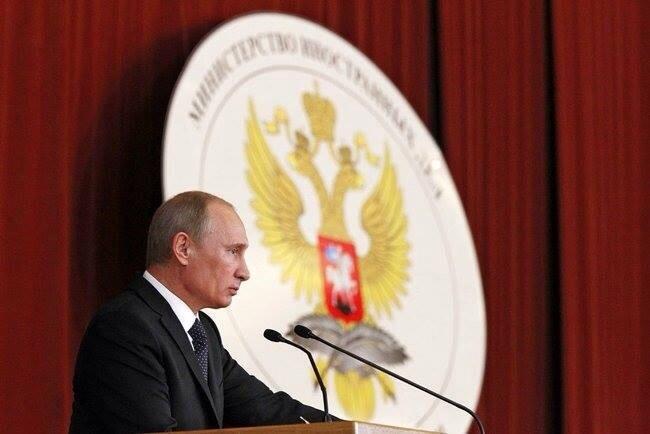
Russia's President Vladimir Putin (L) speaks during his meeting with Russian ambassadors, envoys and diplomats at the Foreign Ministry headquarters in Moscow, on July 1, 2014, with Foreign Minister Sergei Lavrov (R) listening.


Russia is involved in a historic effort to defend its civilization, President Vladimir Putin said Tuesday, vowing to protect the interests of the Russian community abroad as violence again escalated in Ukraine.

Hours after Ukrainian President Petro Poroshenko ended a cease-fire and renewed his assault against pro-Russian separatists in Ukraine’s southeast, Putin compared Ukraine to Iraq, Syria and Libya and said that he could not stand by as a nation with close historical ties to Russia was taken over by people he dismissed as “neo-Nazis.”
Putin made no specific commitment to increasing Russia’s involvement in the roiling southeast region of Ukraine, but he indicated that he would blame Poroshenko for any violence in Ukraine going forward. It was a hint that a stretch of conciliatory efforts from the Kremlin after Ukraine’s May 25 presidential election may be at an end.

Poroshenko has “taken up full responsibility for the continuation of this military campaign,” Putin said in a nationally televised speech to a Moscow gathering of Russia’s ambassadors.
“We in Europe all need a safety net, so the Iraqi, Libyan, Syrian and Ukrainian precedents will not turn into an infectious disease,” Putin said, warning that European countries may be less stable than they appear.


Poroshenko has “taken up full responsibility for the continuation of this military campaign,” Putin said in a nationally televised speech to a Moscow gathering of Russia’s ambassadors.
“We in Europe all need a safety net, so the Iraqi, Libyan, Syrian and Ukrainian precedents will not turn into an infectious disease,” Putin said, warning that European countries may be less stable than they appear.
“Everything that Russia has been fighting for since the time of Peter the Great and maybe earlier — the historians will know better — all of that was at risk. And I want everyone to understand. Our country will continue to defend the rights of Russians, our compatriots, abroad and to use our entire arsenal — from political and economic means to the right to self-defense, as provided for in international law.”

Russia's President Vladimir Putin, right, and Foreign Minister Sergey Lavrov Russian Ambassadors during their meeting in the Foreign Ministry, in Moscow, July 1st 2014.

His speech came as Ukrainian security forces on Tuesday pressed an assault against pro-Russian separatists in the east of the country, hours after Poroshenko suspended a 10-day cease-fire that had brought only limited tranquility and no permanent peace.
Both sides appeared to be digging in for a protracted conflict, as separatists said Tuesday that they would be willing to return to the negotiating table only if Ukrainian security forces pulled out of eastern Ukraine — a demand that Poroshenko has flatly ruled out.

Four people died Tuesday and five were wounded when a minibus came under fire near the eastern town of Kramatorsk, the Donetsk Regional Administration said in a statement. It said that an investigation was still underway and did not make clear whether rebels or Ukrainian security forces did the shooting. Rebels early Tuesday opened fire on Ukrainian military airplanes at the Donetsk airport, the Donetsk mayor’s office said.

Poroshenko on Tuesday said he would restart military operations against separatists in the east of the country, vowing to strike a blow against rebels after a 10-day cease-fire ended with no peace deal.

oroshenko made a televised address: We will attack, and we will free our country 01/07/2014

Declaring in a nationally televised speech that pro-Russian separatists who have seized territory in the east had met none of his demands for peace talks, Poroshenko said that he would be ready to return to the negotiating table if his opponents released hostages, allowed international monitors on the borders and halted weapons flowing in from Russian territory.


“We will attack and defend our land,” Poroshenko said in the speech, which came after an hours-long meeting with his advisers. Protesters had gathered outside his offices in Kiev to push for an end to the cease-fire, which many on the pro-government side had worried was simply giving the separatists a chance to regroup and rearm. In the speech, Poroshenko guaranteed Russian-language rights and more regional autonomy, two key demands of Kiev skeptics in the country’s rebellious industrial heartland in the east.

Russian leaders on Tuesday condemned the truce’s end and called for a return to peace talks.

“We think that it is simply impossible to restore peace, justice, law and order in Ukraine without a truce and without starting dialogue,” the chairman of the lower house of Russia’s parliament, Sergei Naryshkin, said on Tuesday, according to the Interfax news service.

Violence had continued during the 10 days of the cease-fire, but its intensity had lessened, Ukrainian officials had said in recent days. The official end to the break in hostilities appeared to stall halting attempts to bring the sides to the negotiating table, and it raised the prospect of strengthened sanctions by the European Union and the United States against Russia.


E.U. leaders on Friday suggested that they would slap Russia with more sanctions if it did not take concrete steps to seal its porous border with Ukraine and ensure that separatists put down their arms. U.S. officials also have indicated that they are poised to increase measures against Russia. White House spokesman Josh Earnest said Monday that the Kremlin needed to take “tangible actions” to avoid more sanctions.

Poroshenko spoke on Sunday and Monday to Putin, German Chancellor Angela Merkel and French President François Hollande in a last-ditch effort to prolong the cease-fire, Hollande’s office said.

Ukraine’s Foreign Ministry said that 27 troops had been killed after Poroshenko announced the cease-fire June 20.

Russian Foreign Minister Sergei Lavrov on Monday called for a “full-fledged peace process” as soon as possible, the foreign ministry said. Russia is willing to post Ukrainian and international observers in its own posts along the border with Ukraine, Lavrov said, an apparent effort to satisfy a European demand that separatists hand back Ukrainian border points that they have seized in recent weeks.

Russia's foreign minister, Sergei Lavrov

Pro-Russian separatists have said they would be willing to engage in full negotiations only if Ukrainian troops make a full withdrawal from territory that they have claimed as sovereign and independent — an unlikely step, since Ukrainian authorities have said that they worry that doing so would simply allow their opponents to rearm.

Meanwhile, a top American NATO official renewed accusations Monday that Russia has been supporting the separatists with weapons and other support, a charge Russian officials have denied.
“There are some good words about a cease-fire and peace, but what we see is continued conflict, continued support of the conflict from the east side of the border” with Russia, the commander of NATO forces in Europe, Air Force Gen. Philip Breedlove, told reporters in Washington.

The Commander of NATO forces in Europe, Air Force Gen. Philip Breedlove

Also Monday, Russia’s state-run Channel One announced that a cameraman, Anatoly Klyan, 68, died near the eastern city of Donetsk after a bus he was traveling on came under fire, apparently from the Ukrainian military.

Russian tanks openly moved to Luhansk, eyewitness says

ZIK: 30 June 2014


In broad daylight, terrorists are moving Russian tanks to Luhansk towed on platforms, journalist Denis Kazansky writes on Facebook today.

“Let me describe how Luhansk looks like today.


While Olland, Putin and Merkel are persuading Poroshenko to extend the ceasefire, Russian tanks are openly being towed on platforms to Luhansk,” he wrote.

The terrorists have used the unilateral ceasefire to regroup and strengthen their positions, media reports confirm.

Poroshenko restart anti-terrorist operation amid ongoing attacks by Kremlin-backed separatists

Kyiv Post: 30 June 2014


Ukrainian President Petro Poroshenko (C), wearing military fatigues, speaks with Ukrainian army's Anti-Terrorist Operation (ATO) officers at their headquarters near the eastern Ukrainian city of Izyum, during his visit of the Donetsk region, on June 20. Poroshenko is expected to end the ceasefire because of ongoing attacks by Kremlin-backed separatists.


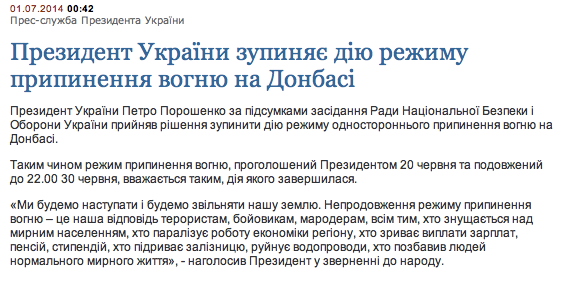
Ukrainian President Petro Poroshenko vowed on July 1 to launch a military offensive against Kremlin-backed "terrorists" in eastern Ukraine, ending a 10-day self-imposed truce that Ukrainian authorities said was violated more than 100 times by the separatists who killed 27 Ukrainian troops.

"We will attack and we will liberate our land. The end of the ceasefire is our response to terrorists, rebels, looters, all those who mock the civilians who paralyze the economy of the region; who rip the payment of salaries, pensions, stipends; who undermine the railroads, destroy water pipes, those who deprive a normal peaceful life," according to a statement on Poroshenko's website.


Embedded image permalink
President Poroshenko's in his statement: said he decided to stop "truce" at E Ukraine.stressing out "We will liberate own land"

Poroshenko is also expected to impose a martial law in Donetsk and Luhansk oblasts as part of a bid to end the separatist uprisings that began in April and have claimed the lives of more than 180 Ukrainian servicemen, including at least 20 since the ceasefire was announced on June 20.

A Voice of America alert quoted General Philip M. Breedlove, the NATO commander, as say that Russian military forces are actively assisting the movement of forces, equipment and finances into Ukraine. "There are several types and capabilities of heavy weaponry that are moving across the border," Breedlove was quoted as saying.

Pro-russian troops prepare to travel in a tank on a road near the town of Yanakiyevo, Donetsk region, eastern Ukraine, Friday, June 20, 2014.


Some sources in Poroshenko's administration said that martial law might be introduced in just some parts of Donetsk and Luhansk regions.

Poroshenko had not taken to the airwaves by midnight, but member of parliament and Radical party leader Oleh Liashko posted on his Facebook page that Ukraine's anti-terrorist operation has resumed and that martial law would be imposed. Liashko ended his message with: "God help Ukraine! Glory to Ukraine! Death to its enemies!"


Read more here: http://www.ledger-enquirer.com/2014/06/30/3178494/ukraines-president-faces-decision.html#storylink=cpy
Slovyansk is a town almost encircled by Ukrainian ATO forces

On June 30, Russian President Vladimir Putin urged Poroshenko to continue the ceasefire, according to a Kremlin statement released after a phone call that also included French President François Hollande and Germany's Chancellor Angela Merkel. Putin, on the other hand, was urged by the other parties to actively denounce separatism in the east of Ukraine, which Russia is supporting.

Russia, however, has done little to bring peace since the phone call, despite the fact that the European Union ultimatum to Russia came to an end at 10 p.m. on June 30. EU threatened with a third round of sanctions if Russia did not work for peace.

Poroshenko will need the Verkhovna Rada's approval to impose martial law and is expected to consult with lawmakers about doing so this week, which is the last week before the summer recess.

The United States have made an early signal that they will support Poroshenko's decision. State Department spokesperson Jen Psaki said during her daily press briefing on June 30 that a ceasefire extension is up to Ukraine, and that the U.S. will support whatever decision the president makes.

On top of resumption of the ATO, Poroshenko is said to be contemplating major changes to the heads of law enforcement agencies, steps that also will require parliament's approval.

Curent situation on the lines of fire.

He consulted independent deputies in parliament earlier today on this issue.

Anatoliy Hrytsenko, a former defense minister who was present at the meeting, said the president announced cleanup of law enforcement commandment at the meeting.
“There are three staffing decisions planned: change of commander of headquarters (it's within presidential powers) , and introduction in the Rada and appointment of the minister for defense and vice prime minister who will coordinate in the government the law enforcement and defense sectors, primarily their material and technical supplies and logistics,” Hrytsenko said on his Facebook page.

He said the president planned to decide on the candidates today. Hrytsenko also said that heads of the Security Service, interior ministry and border guard will likely remain in place.