25 February 2015

Russian tanks reportedly shell Ukrainian positions near Shirokino

The Interpreter: 25. February 2015


армия рф агрессия оккупанты вторжение

Novosti Donbassa reports that Zoryan Shkiryak, an adviser to the minister for internal affairs, has announced that Ukrainian troops near Shirokino, where Russian-backed fighters are pressing a counter-attack after the village was retaken by Ukraine on February 10, were attacked today by Russian tanks.
The Interpreter translates:
"Today at 10:40 [8:40 GMT] Russo-terrorist troops fired on ATO forces' positions near Shirokino with tanks. The terrorists have been strengthened in this area with two more Russian T-72 tanks. There are now 4 such armoured units outside Shriokino, as well as mortars (120 mm and 82 mm) manned by militants. Enemy self-propelled guns and conventional artillery are based in the Sakhanka area," he said.
He said that the ATO forces had responded to the militants' attacks with a tank strike.
Dmitry Chaly, the spokesman for the Ukrainian military headquarters in Mariupol, told UNN that two Ukrainian servicemen had been wounded outside Mariupol over the last 24 hours.
Chaly said that there had been 9 shelling attacks conducted by Russian-backed forces yesterday.
The Interpreter translates:
"There 9 shelling attacks and 2 military confrontations yesterday. The militants shelled Berdyanskoye, Lebedinskoye and Tavricheskoye once each. All the other shelling attacks were aimed towards the Shirokino area."

150225-mariupol-maps.png


-- Pierre Vaux
published in Press-Stream Ukraine Live Day 373 in Publication Ukraine Liveblogs

армия рф агрессия оккупанты вторжение


Popasnaya suffers heavy shelling overnight, part of town left without water or electricity
 
Ukrainska Pravda reports that the press office of the governor of the Lugansk region, Hennadiy Moskal, has announced that the town of Popasnaya, north-east of Debaltsevo, came under intense bombardment last night.
The Interpreter translates:
Last night, beginning at 23:00 and finishing at 3:00, the town was shelled incessantly with artillery and mortars. Shells exploded every 10 minutes. According to local residents, last night was the most intense for the last two weeks.
Most damaged of all were the Chermushki neighbourhood (large blocks of flats) and Kapura (residential area). Gas pipes and electricity lines were cut in many areas, several streets have been left without such essential services.
Residential areas of the town are still without running water. Repair teams are attempting to bring services back online. Mobile communications went down after the attack but have now been restored.
There were no reports, the press office said, of civilian casualties.
Moskal claimed that the town had been shelled by the "Cossacks of the Great Don Army," a Russian-backed separatist group operating in neighbouring Stakhanov.
Ukrainska Pravda notes that the group has repeatedly stated that they did not sign any agreement in Minsk and will therefore not comply with the ceasefire stipulated in that deal.

-- Pierre Vaux
Published in Press-Stream Ukraine Live Day 373 in Publication Ukraine Liveblogs

The Ukraine plan

 Christo's blo: 25. February 2015


Following is a rough but semantically correct translation of the full text of the “Ukraine Strategy Document”, dated somewhere after February 4th 2014 and prior to February 15th 2014, leaked today by Novaya Gazeta:

1. In assessing the political situation in Ukraine one must recognize, firstly, the bankruptcy of President Viktor Yanukovych and the fact that his ruling “family” is rapidly losing control of the political process;
 
Secondly, the paralysis of the central government and the country’s lack of a clear political entity with which the Russian Federation could negotiate; Third, the low probability of occurrence of consensus on this topic after the early parliamentary and presidential elections that Viktor Yanukovych announced on February 4th.
 
If the Russian oligarchy is balanced off by a powerful bureaucratic class, the Ukrainian state machinery is obviously weaker than oligopolies; it, like the sphere of public policy, is under the control of the oligarchs. Namely the oligarchs (R. Akhmetov, D. Firtash, I. Kolomoisky and others) govern the Kiev political community, including the Verkhovna Rada and the systemic opposition. Non-systemic opposition (the so-called Independence), on the other hand, is beyond the control of the leaders of the systemic opposition; here the tone is set by “warlords” (in large part – football fans and representatives of the criminal underworld), who do not have electoral support and, apparently, are not so much under the control of oligarchic groups, but largely of Polish and British intelligence services. At the same time, many oligarchic groups have also funded the Maidan movement, in order “not to put eggs in one basket.”
—–
President Viktor Yanukovych – a man of low moral character, is afraid to hand over the presidency and at the same time is ready to “give up” the security forces in order to guarantee the conservation of his post of President, and his safety after leaving this post. Meanwhile, those units of the “Berkut”, which are used to quell the unrest in Kiev, are formed mostly of locals of the Crimea and Eastern regions. According to local observers, any attempt by Yanukovich’s successor to organize a repression against the Interior Ministry and SBU, as a penalty for the suppression of the Maidan, will inevitably be met with harsh reaction force. Furthermore, there is no knowing what the position of the Ukrainian army will be; it, according to the Ukrainian Defense Ministry employee, is “locked in barracks and the officers are guarding the weapons depots so that, God forbid, they do not fall into the hands of contracted soldiers, who would – in this case – start shooting at each other” .
…..
 
Early parliamentary and presidential elections could be the reason for a new round of a public-rallies-turned-into-assault civil war, deepening the East-West electoral divide and ultimately accelerating the disintegration of Ukraine.
 
The course and outcome of the Munich conference provides a reasonable basis to believe that:
 
– The European Union and the United States assume the possible disintegration of the country and do not even consider this development extraordinary. The concept of “piecemeal” absorption of a large Eastern European country by the EU is not only publicly articulated by a number of official EU speakers, but finds supporters in the ranks of the Ukrainian elite.
Will Russia participate in this geopolitical intrigue?
 
2. Russia’s policy towards Ukraine should finally become pragmatic.
 
First, the regime of Viktor Yanukovych has finally gone bankrupt. Its continued political, diplomatic, financial, and information support by the Russian Federation no longer makes any sense.
 
Second, in an environment where sporadic civil war in the form of urban guerrilla war from so-called “supporters of Maidan” against the leadership of a number of areas in the East of the country has become a fact, and the disintegration of the Ukrainian state under the geographical demarcation of regional alliances “Western area plus Kiev” and “Eastern regions plus Crimea” has become part of the political agenda, under these conditions.
 
Russia must in no case limit its policy in Ukraine only to attempts to influence the political situation in Kiev and the relationship of systemic opposition (Yatsenyuk, V. Klitschko, O. Tyagnybok, Poroshenko and others.) with the European Commission.
 
Third, in almost complete paralysis of the central government, unable even under the threat of default and the absence of “Nafgogaz” funds for payments for Russian gas to form a responsible government, Russia is simply obliged to intervene in the geopolitical intrigue of the European Community, directed against the territorial integrity of Ukraine.
 
First of all, because otherwise our country is in danger of losing not only Ukrainian market of energy, but what is much more dangerous, even indirect control over the Ukrainian gas transportation system. This will endanger the position of “Gazprom” in Central and Southern Europe, causing huge damage to the economy of our country.
 
Pro-Russian rebels hand off bodies of Ukrainian soldiers killed in Debaltseve at a checkpoint near Horlivka on February 24.
 
 
3. The Constitution of Ukraine in any case is unable to provide a mechanism for a legitimate way to start the integration of Eastern Ukrainian and Crimea into the legal framework of the Russian Federation.
 
As stated in Article 71 of the Ukraine Constitution, the questions of changing its territory are settled exclusively by an all-Ukrainian referendum. Meanwhile a referendum, in accordance with Article 72 of the Constitution of the country, may be proclaimed by popular initiative at the request of at least three million Ukrainian citizens eligible to vote, provided that the signatures of the referendum are collected in no less than two-thirds of the area and not less than one hundred thousand signatures are from each region.
 
However, as paradoxical as it sounds, for the Russian-Ukrainian integration process, there has already exists a legal framework: the so-called system of Russian-Ukrainian Euroregions, members of the Association of European Border Regions (which, in turn, is a member of the Assembly of European Regions). Thus, the Euroregion “Donbass” includes the Donetsk, Lugansk, Rostov and Voronezh regions, the Euroregion “Sloboda” – Kharkov and Belgorod region, the Euroregion “Dnepr” – Bryansk and Chernihiv regions and so on.
 
Russia, using the legitimate – from the point of view of the EU – legal instruments of Euroregions, should ensure the conclusion of contracts on cross-border and near-border cooperation, and then establish a direct state-contract relations with those Ukrainian territories, in which there is persistent pro-Russian electoral sympathy.
 
First of all – with the Republic of Crimea, Kharkiv, Luhansk, Zaporizhia, Mykolaiv, Dnipropetrovsk and to a lesser extent – Kherson and Odessa areas. (This list deliberately – and rather conditionally – excludes the Sumy region and Donetsk region. The first – because of the very high electoral influence in her party “Batkivschina.” The second – due to the close business and political ties between the local business elite, led by R. Akhmetov, with a number of representatives of the opposition oligarchic alliance with its extensive interests here.)
 
Local elites are more motivated than ever to accept half-way integration initiatives coming from Russia. Before the crisis, East Ukrainian elites preferred a “weak Kiev” to a “strong Moscow”, but now, under threat of losing everything, they are not going to meekly wait for the massive clean-up operations (including those based on the compromising “economic” material accumulated in Kiev), which inevitably will be undertaken by the central government no matter what political forces will be part of the “new consensus” after the departure of Viktor Yanukovych as president of Ukraine. Under these conditions, they are willing to sacrifice their “independence”.
 
Current events in Kiev convincingly show that the time of Yanukovych in power could end at any moment. Thus, the window of opportunity for an adequate response from Russia is getting narrower. The number of dead rioters in the capital of Ukraine is direct evidence of the inevitability of civil war and the impossibility of consensus, with preservation of the Yanukovych presidency. Under these conditions it seems right to play on the centrifugal aspirations of different regions of the country, with the aim, in one form or another, to initiate the accession of the Eastern regions to Russia. Priority regions for makings such efforts should be the Crimea and the Kharkiv region, where there are already strong enough groups supporting the idea of maximum integration with Russia.
 
 
4. Of course, Russia, taking on itself the support of the Crimea and some Eastern areas will be forced to take on the onerous, in its present position, budgetary costs. Undoubtedly, this will affect the macroeconomic stability and growth prospects of the economy. However, from a geopolitical point of view this will be an invaluable win: our country will have access to the new demographic resources at its disposal; and highly qualified workforce in industry and transport. In addition, it can count on the emergence of new Slavic migration flows from West to East – as opposed to the current Central Asian migration trends. The industrial potential of the Eastern Ukraine, including the military-industrial sector, included in the Russian military-industrial complex, will allow faster and more successfully to implement the program of re-arming of the Armed Forces.
 
What is equally important, a constructive, “smoothing” Russia’s participation in the highly probable disintegration of the Ukrainian state will not only give new impetus to the integrationist projects of the Kremlin, but also will allow our country to preserve, as mentioned above, the control over the Ukrainian gas transportation system. And at the same time significantly to change the geopolitical situation in Central and Eastern Europe, returning to Russia one of the major roles here.
 
5. To start the process of “pro-Russian drift” of the Crimea and Eastern Ukrainian territories, it is crucial today to create events that can give this process political legitimacy and moral justification; as well as to build a PR-strategy, which will present the actions by Russia and pro-Russian political elites of the South and East of Ukraine, as forced and reactive.
 
Recent developments in Western Ukraine (Lviv, Volyn, Ivano-Frankivsk region), in which the opposition declared their independence from the authorities in Kiev, give grounds to declare Eastern regions to declare their own sovereignty, with their subsequent re-orientation to the Russian Federation.
 
 
6. The reactions in Eastern Ukrainian regions should be two-layered by structure and scenario:
 
Members of disobedience activities should require the Verkhovna Rada to expand the format of the constitutional reform, discussed by the Ukrainian parliament, including the simplification of the procedure for organizing a nationwide referendum:
 
“We cannot be held hostage to the Maidan. The unitary state system of Ukraine, which allows violent nationalist minority population to impose their choice throughout the country, should be reconsidered. Russia is a federal state, and there such thing is unthinkable. Strengthening the legal ties with the state of Russia, we will strengthen the integrity of the Ukrainian state. “
 
Initially, the protesters should articulate their unwillingness to be “hostages of the Maidan”, of its attempts to usurp the right of other regions and the majority of the population to make its own civilization and political choice, the rejection of the “ideology of the civil war and split the country”, which is professed by political representatives of Western-Ukrainian elites.
 
Demonstrators, rallying under the Russian flag should not insist on changing the constitutional order. They should impute strong condemnation of “Western separatists, attacking – with the input of their foreign masters – the territorial integrity of the country“, as well as the requirements of the early development of “associative relations of Eastern regions of Ukraine and the Russian Federation”: “We are with Russia. No civil war. “
 
Slogans of the moment should be fair reluctance “to support tax deductions for the pro-fascist forces” of Western Ukraine and the government depending on them, which orients is policies on the demands of the European Union, and not on the needs of its citizens.
 
It is advisable to consistently reuse three slogans, with each of them logically stemming from one another:
 
  • – The requirement for the “federalization” (or even confederation) as a guarantee for these regions from interfering by pro-Western and nationalist forces in their internal affairs;
  • – Independent from Kiev accession of the Eastern and South-Eastern areas at the regional level into the Customs Union, which will provide the necessary conditions for the normal operation and development of the industry;
  • – Direct sovereignization followed by the accession to Russia, as the only guarantor of sustainable economic development and social stability.
 
The political movement for pro-Russian choice and associative relations of Eastern and Southern Ukrainian territories with the Russian Federation needs to be constituted on an organizational level and registered legally. For this it is necessary to prepare conditions for referenda in the Crimea and Kharkiv region (and then in other regions), that put to the vote the issue of self-determination and the further possibility of joining the Russian Federation.
 
Crucial is the organization of an informal meeting of the leaders or representatives of the Eastern regions of Ukraine in Moscow, where they will, by a person having sufficient representative power, would be given support and political guarantees (even if only oral). Such representatives of the East elite are, for example, H. Dobkin (Mayor of Kharkov), Konstantinov (Chairman of the Supreme Council of the Republic of Crimea), S. Aksenov (chairman of the party “Russian Unity”) .
….
Extremely important is that the “world community” would have as little reason to doubt the legitimacy and fairness of the referendum.
To do this, it seems appropriate to ensure the referendum process with modern means of verification (webcam and online translation). A Preliminary plan of work has already been developed and can be implemented within two weeks.
 
7. It is necessary to support these events with a PR-campaign in the Russian and Ukrainian press.
Including – by developing and launching into media circulation concept papers, a kind of manifestos, of the East and the West Ukrainian separatism movements. A wide range of public figures in Russia must speak out in support of the accession of the Eastern regions of Ukraine to Russia (a possible slogan may be “Putin 2.0 – give us Pereyaslavskaya Rada 2.0″).

23 February 2015

Ukraine shuts down border posts with Russia

Kyiv Post: 22. February 2015
by Olena Goncharova


Armoured Personnel Carriers (APCs) of the Ukrainian border guards drive past a newly constructed part of the border near the Goptivka border crossing on the Urkainian-Russian border, north of Kharkiv, eastern Ukraine.


Ukraine has closed 23 checkpoints on the border with Russia as the Kremlin build up forces close to the strategic port city of Mariupol, situated between Russia and Crimea in Donetsk Oblast.
On Feb. 20, Ukraine's government issued a decree ordering the closure of one international, four interstate and 18 local border crossing points in Luhansk, Donetsk, Kharkiv, Sumy and Chernihiv oblasts.
A total of 39 checkpoints will still operate on the border with Russia, the State Border Service said. Three are located in Chernihiv Oblast, 14 in Sumy Oblast, 15 in Kharkiv Oblast, six in Luhansk Oblast and one in Kyiv Oblast.
 
Ukraine's Cabinet of Ministers in Ukraine had already suspended crossings at 14 border posts (6 in Donetsk Oblast and 8 in Luhansk Oblast), due to a direct threat to the lives of those attempting to cross.
At that stage the border posts closed were Marynivka, Novoazovsk, Uspenka, Ilovaisk, Kvashyno, Donetsk, Dovzhansky, Chervona Mohyla, Izvaryne, Krasna Talivka, Yuhanivka, Herasymivka, Petrivka and Luhansk.
Viktoria Siumar, a former National Security and Defense Council official and a member of Prime Minister's Arseniy Yatsenyk People's Front, supported the decision.
“Ukraine is weak and can't defend itself as long as the country's borders are not protected," Siumar told the Kyiv Post. “It's a key priority task. When Ukraine doesn't control its borders Russia can influence the situation."
Siumar earlier said that “the Wall", an ambitious construction project announced by the Ukrainian government in early September, could be a great help in defending the country. The plan is to tighten security along the whole perimeter of the Russian border, which stretches along 2,295 kilometers.
 
The government plans to equip the border with ditches, vehicle-barrier trenches and high-tech surveillance towers to detect troop and vehicle movement from the Russian side.
In October, Yatsenyuk predicted that the wall will cost €66 million to build. Some months later, on Feb. 11, during the Cabinet meeting Yatsenyuk said that the government would try to halve the cost of the construction work, while some work has already started in Kharkiv Oblast.
 
Oleksandr Turchynov, who heads the National Security and Defense Council, said that Russia is doing its best to prevent Ukraine securing its border with the country.
"All Russian-terrorist groups staying in the occupied territory understand that as soon as the border is closed they will not stand even for several weeks, so Russia is blocking the [border closure] decision-making in every possible way," he said in Kyiv on Feb. 21 at the exhibition of Russian weapons captured from separatist and Russian forces during battles in the east of Ukraine.
Turchynov also believes closing the border is the first task that should be solved, and needs to be directly addressed by the participation of a peacekeeping mission.
However, some experts think the closure of the border should have been done much earlier, and is in fact well overdue.
“It would have started in summer, but now when Russian tanks and trucks loaded with ammunition cross the border almost daily it won't help much," Viacheslav Tseluiko, a military expert at the Center for Army, Conversion and Disarmament Studies, said. “If they couldn't enter the country via a checkpoint they would probably find another way."
According to Tseluiko, this step could only become effective if complemented by additional measures such as strengthening the border with engineering constructions and armed patrols.
 
Pavlo Kyshkar, a Donbas Battalion member and Samopomich Party lawmaker, was skeptical about the decision.
“This step may be a sign that Ukraine's officials are considering options of readiness for the introduction of martial law," Kyshkar says. “But the checkpoint closure in general won't solve our problems, it would be effective probably in Kharkiv Oblast only."

Ukraine exhibits Russian weapons captured in Donbas

Kyiv Post: 23. February 2015
Photo — by Volodymyr Petrov


People gather around a rocket on display in Kyiv as part of an exhibition of Russian weapons captured in the Donbas during battles in the east of Ukraine.
 
An exhibition of Russian weapons captured from separatist and Russian forces during battles in the east of Ukraine opened in Kyiv on Feb. 21. The exhibition called "Presence" aims to prove Russian military involvement in Ukraine.

The continued fighting in eastern Ukraine has made a mockery of the West's latest attempts to negotiate a cease-fire, but may ultimately pave the way for a more durable peace, analysts say.
On Feb. 17, NATO Secretary General Jens Stoltenberg said that the alliance had evidence Russia is helping fighters of the self-proclaimed Donetsk and Luhansk people's republics. On Feb. 18, the British embassy released photos of 96K6 Pantsir-S1 surface-to-air missile systems spotted in a number of eastern Ukrainian cities, including Shakhtarsk and Donetsk, via its social media pages. The complex Russian equipment can only be operated by highly trained regular forces.
Ukraine's Defense Minister Stepan Poltorak showed up at the exhibition and said that Ukraine is permanently strengthening its defense. Poltorak also hopes that foreign partners will provide aid to the country.
"Russia has brought a lot of equipment [to militants]," Poltorak said in Kyiv on Feb. 21. "They brought enough to arm a small European state."
Ukraine's President Petro Poroshenko had earlier shown Russian passports taken from Russian soldiers to demonstrate the presence of Russian troops in the country while speaking at Munich Security Conference on Feb. 7.


A girl looks on as Ukrainian president Petro Poroshenko and top officials from the EU light candles during a public prayer, part of the 'March of Dignity' on Feb. 22 in Kyiv.


Poroshenko showed European leaders Russia-supplied weapons from Donbas
 
Dignity March in commemoration of those killed in the Euromaidan events a year ago in downtown Kyiv was held in Ukraine's capital on Sunday.
Many European leaders, including Polish President Bronislaw Komorowski, Lithuanian President Dalia Grybauskaite, Slovak President Andrej Kiska, European Council President Donald Tusk.

21 February 2015

Pro-Russia victors vow to ignore deal for ceasefire in Ukraine

The Guardian: 21. February 2015
by Alec Luhn in Debaltseve


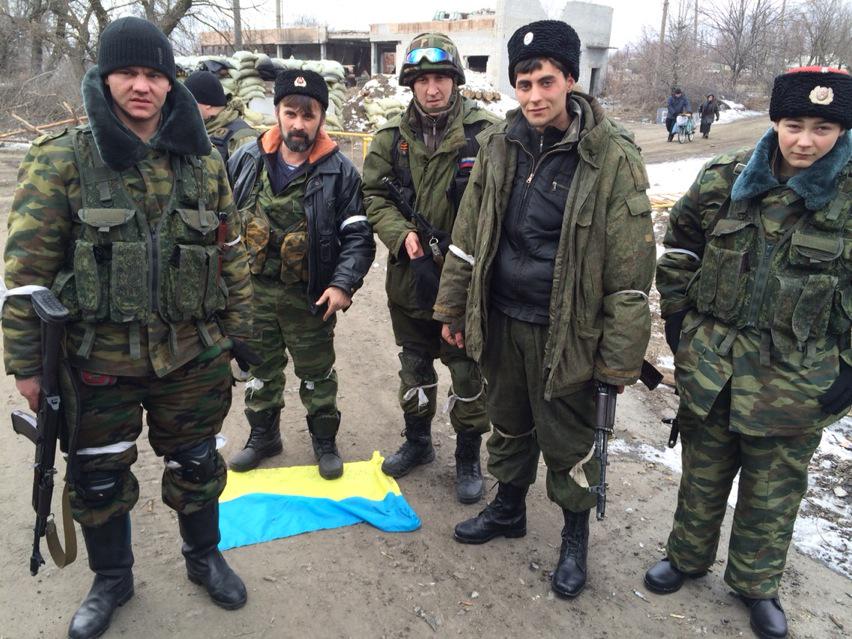
Russian Cossack soldiers and Ukrainian flag - Debaltseve, Feb. 20.

EU leader warns of ‘further action’ if diplomacy fails as rebels’ leadership vacuum imperils peace efforts 

As the sun set over the cratered fields around Debaltseve, a group of pro-Russia Cossack fighters were retrieving boxes of anti-tank artillery rounds and two armoured vehicles left by Kiev’s forces on the side of the Rostov-Kharkiv highway, which was littered with mangled cars and turret-less tanks.

Shattered petrol stations and garages attested to weeks of intense fighting for the strategic town. Two troop transport trucks that had crashed into each other, scattering boots and clothing, spoke of the Ukrainian forces’
rushed, chaotic retreat this week.
“Donetsk and Luhansk regions are our home. We will take back our land,” said Andrei Dyomin as he tethered one broken-down fighting vehicle to a truck. “Every ceasefire they move up their armour and start killing us again. There won’t be a ceasefire, there will be war.”

As if to illustrate his words, barrages of artillery and rocket fire boomed across the fields from the direction of the frontline as he spoke. The capture of the key rail junction town of Debaltseve, where Ukrainian troops had been surrounded and almost entirely cut off from their main lines, satisfied Russian president Vladimir Putin and rebel leaders’
main grievance with the peace plan agreed in Minsk last week. But though fighting has quieted, violations of Sunday’s ceasefire continue.
 

Facebook Twitter Pinterest A resident rides a bicycle passing by an armoured vehicle in Debaltseve.

Many pro-Russia fighters in Debaltseve said they didn’t believe the truce could last and vowed to fight further to take back government-controlled areas of Donetsk and Luhansk regions. Concerns are rising that the separatists may still be aiming to take Mariupol, a government-held city on the Sea of Azov.

On Friday, pro-Russia rebels were celebrating their victory in front of the windowless town hall as relieved locals emerged from the basements and bomb shelters were they have spent much of the last month. A truck from Donetsk delivered medicine and food to a vacant store. Fighters and residents lined up to kiss a 200-year-old icon called the Tikhvinskaya rebel, which could make fighters invisible and cause enemies to kill each other, according to the Russian Orthodox activists who had brought it from Moscow. “We wanted to set up this icon to become a symbol for the ceasefire,” a Russian activist named Alexander Titov said.

In a positive sign for the peace plan agreed in Minsk last week, the Guardian saw at least a dozen multiple rocket launch systems driving further into rebel territory from the area near Debaltseve and Perevalsk, as well as numerous trucks carrying ammunition – both sides were supposed to begin pulling back heavy weapons on Tuesday to create a buffer zone of up to 140km (87 miles). Although Donetsk and Luhansk leaders said they had begun pulling back weapons, ceasefire monitors from the Organisation for Security and Cooperation in Europe said on Thursday they had
not yet seen evidence of a full withdrawal.

Ukrainian army command said it had drafted a plan of action according to which “weapons will be simultaneously withdrawn by both sides”. But occasional distant shelling could be heard all afternoon in Debaltseve, including at least one volley from a multiple rocket launcher.
 

Residents line up waiting for a delivery of aid as a Russia-backed rebel guards a pile of weapons and ammunition outside an administration building.
 
Meanwhile, Donald Tusk, the European council president, said EU leaders were considering new sanctions to pressure separatists in eastern Ukraine to stick to the ceasefire agreement. He said there had been “more than 300 violations” of the truce since last weekend, when it was supposed to begin, and warned that the EU is “reaching a point when further diplomatic efforts will be fruitless unless credibly backed up by further action”.
About 5,000 of 25,000 residents have remained in Debaltseve, according to Alexander “Greek” Afendikov, commander of the Orthodox army fighting unit who was appointed mayor of Debaltseve on Thursday by Alexander Zakharchenko, the head of the Donetsk People’s Republic. He claimed 80% of Debaltseve’s residential housing had been ruined in the fighting.

While that figure may be exaggerated, the destruction was wide-reaching. Shell impacts had blown huge gaps in the sides of apartment buildings and caved-in one-storey homes, concrete walls were full of bullet and shrapnel holes, and unexploded mortar and artillery rounds protruded from the road in several places. A tyre marked “mine” near the railway station reminded of the Cossack who was killed when his car hit a mine on Thursday. The head of a Soviet hero of labour statue had been partially blown off.

But besides downed electric lines and a damaged station, the town’s railway lines, which connect the capitals of the Donetsk and Luhansk separatist republics, appeared to be mostly intact. Zakharchenko has promised they will be used to transport coal, the region’s traditional export.


A girl leans on a cart used to carry tree branches for fire, outside a damaged apartment building.

Residents said there had been no electricity or water since heavy shelling began on 22 January, and homes were barely warmer than the frigid weather outside. Pensioner Lyudmila Shirina said her and her daughter’s one-storey houses on the outskirts had been destroyed by shelling on 9 February, after which she had started living in a bomb shelter beneath a small apartment block. A shell hit the roof of that building on Wednesday, she said.
“Today is the first day it’s been quiet, but we don’t say that word, as soon as we even think it, [government forces] start shooting again,” Shirina said, adding that a wide variety of incendiary rockets had been hitting the town.

Although she said Ukrainian troops had dug in positions in the gardens of homes on the outskirts, she nonetheless blamed the destructive incoming fire on Kiev’s forces, claiming they often shelled their own men. “We’re sick of war, but we want [president Petro] Poroshenko and his kids to experience what we did,” she said.
Afendikov promised that “there will be complete peace here” in the future. Asked about the sound of occasional shelling in the distance, he said he didn’t know which side was shooting.

Pavel Grebnov, a doctor from the Russian city of Khabarovsk who is fighting with the rebels, argued that both sides were breaking the ceasefire but pro-Russian forces received most of the blame. “There are people who lost family members, who want revenge, they don’t want a ceasefire,” he said about isolated ceasefire violations from the rebel side.


A dog sits next to a Russia-backed rebel near his tank. Photograph: Vadim Ghirda/AP

A grizzled fighter with a Kalashnikov and a chest full of medals, which he said were from tours as a lieutenant colonel in the Soviet army, vowed to fight on in the Kharkiv, Dnipropetrovsk and Zaporizhya regions, arguing that “the ceasefire doesn’t relate to us” because of violations by Kiev’s forces. The man, who would give his name only as Valera, admitted that “they’re not letting us go forward because of incorrect leadership”. But he promised that his commander, a Russian former colonel named Igor Bezler who was ousted in a power struggle this summer, would soon return and press the offensive. “I can’t promise we’ll go to Kiev, but we’ll get to Kharkiv 100%,” he said.

Perhaps the greatest threat to the ceasefire from the rebel side will be the at times chaotic chain of command. Although they’re based in territory nominally belonging to the Luhansk People’s Republic, the Cossacks with Dyomin said their allegiance was to Pavel Dryomov and Nikolai Kozytsin, two Cossack leaders who have sometimes clashed with the leadership of the people’s republic. The mayor of the frontline town of Popasna told the Guardian on Thursday he blamed out-of-control Cossack fighters for continuing to shell his city despite the ceasefire.

Both Kiev and the separatist republics have reserved the right to respond if fired upon, a command that can easily escalate into open warfare given the disparate groups on the rebel side and the many loosely regulated volunteer battalions among the government forces.
A female rebel fighter who would give only her first name, Anastasia, admitted that “many different orders” came down from the leadership. “When they shoot at us we need to respond, but we’re trying not to,” she said.